 About gDonna
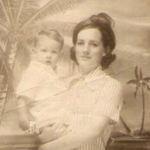
 The photo is my son and myself. Now days you can get a photo made to look old like this one. This photo was taken when this was the new look.
Harry S Truman was president when I was born and world war II had ended. I grew up in a time when lunch was put in a brown paper bag and a sandwich was wrapped with wax paper. There was no such thing as pantyhose, we wore stockings that attached to the rubbery clippy things that attached to the girdle. Convenience stores were not common and when we took a trip we packed a picnic basket because many places did not have fast food. Highways had places to pull over and stop, some with picnic tables. Read more ....
Comments On Article: What Would You Choose...
I don't know how different the textures of wheat berries and buckwheat groats differ, but I used to grind my groats with a plain old blender!
Loving your very much hands-on posts, Pamela N.
Merry Christmas to all - it's mid-morning Christmas Day here in Australia.
Grandma Donna wrote,
Pamela N, you can brain dump all you want, I among others are enjoying the conversations very much!
Merry Christmas everyone!
Grandma Donna
Pamela,
Thanks SO MUCH for mentioning that book. It sounds very interesting, so I bought mine on eBay for a little over $7.00
It seems like if you were starting from scratch with the soap ration you would either have to be toting that bar of soap from kitchen to bathroom the first week or you'd have to cut it in half.
Becky Sue
I've made 100% whole wheat bread using just the home ground wheat. I recently learned that when you use 100% whole wheat, it best to leave the dough sticky and let it rest a bit to allow moisture to be absorbed before adding additional flour if needed. Something about allowing flour to properly hydrate. If you add enough flour in the initial mixing to get it beyond stick, you'll have a dry product.
I usually do not do 100% whole wheat adding white flour as well. I like the end result better.
Grandma Donna wrote,
Just a thought on the homemade wheat bread. Most people today do not soak their grains, I went down that rabbit hole last year after I something about people had stopped soaking their corn and that corn should be soaked in lime water and that releases nutrients such as vitamin B3 and settles the toxins. Our ancestors understood this.
Well that led me into soaked grains. The first thing Charles and I did was to make soaked wheat pancakes. These were the most delicious pancakes we had ever had and this is the way we make them now. Then came the soaked wheat for bread. I can explain in one way that sourdough bread is in a way soaked wheat because the wheat dough rests for a longer period than the way we make bread today.
To make the pancakes we soak the dough or batter if you call it that, some people would call it a sponge too. But we make it up in the evening and soak it overnight.
This started making sense to me because Sarah, in my 1932 diary did her evening chores and one of them was to get her sponge ready for overnight soaking.
I was confused at first because I thought they were soaking the wheatberries and that made no sense at all but they are soaking the wheat flour, the sponge.
I cannot eat gluten very well without feeling bloated but I have no issues with the soaked flour.
It needs overnight or a 24 hour period of soaking and is easy to do. I cannot remember if I did a recipe on the soaked bread, I will link one post that I know of that I mentioned the soaking and it shows the pancakes. I will look to find more posts and if not I can write a post about when I make some soaked wheat bread.
Here is one post. https://gdonna.com/living-like-the-past/they-knew-...
Grandma Donna wrote,
It looks like I will need to do a post on the whole wheat pancakes, I cannot seem to find that I did one. I use Shay Elliott's recipe for the soaked grain whole wheat bread.
Shay has a couple of recipes for this as she started her journey into soaked grain and then revised her recipe
You can do an internet search for Shay Elliott's revised soaked wheat bread recipe an look for her August 15, 2012 recipe. Shay did a lot of work and research about soaked grains. Donna
Thank you, Grandma Donna, for the post about soaking the flour. When our children were growing up, I always mixed up the pancake batter and let it sit over night. I did bake with sourdough then, also, plus ground our wheat. I am gluten intolerant and sorghum flour can be used as a substitute in recipes; cup for cup.
From Wartime Britain 1939-1945 by Juliet Gardiner, (page 180.)
“In November 1942 there was an outcry in the press about people giving food that they had obtained using their ration books to friends and neighbours, which was illegal. Rations were not supposed ‘to be transferable whether by sale, barter or gift except…within the household’. If you didn’t need your rations for your own household, you should not draw them, and if everyone who could be was so self-denying that would save even more shipping space. But of course everyone swapped rations with friends, gave away anything they had an excess of, or contributed what they could on a special occasion such as the making of a neighbour’s daughter’s wedding cake. The nonsense of this regulation meant that you could give a friend a cake but it was illegal to give them the ingredients to make a cake.
Churchill sent a note to the Minister of Food, Lord Woolton, saying that he hoped ‘we are not enforcing vexatious regulations of this kind. It is absolutely contrary to logic and good sense that a person may not give away or exchange his rations with someone who at the moment feels he has a greater need. It strikes at neighbourliness and friendliness.’ “
The regulations were changed so that purchasers of rationed goods were allowed to give some as gifts.
(It is a good thing too as I give some of our surplus eggs to a friend occasionally, and occasionally she gives me some of her spare sugar. Our neighbour, who knows us well, has given us some cheese for Christmas. We are delighted.)
I was reading about the soaps and the rationing going on. Then I remembered that I had a bar of Ivory soap I had picked up at a thrift store for .25! I went to check and see if it had any type of date on it, it does 1943. I compared it just now with a new bar of Ivory. The picture doesn’t show how much bigger the 1943 bar is…it’s a lot. I was floored ( yes I know I knew but didn’t realize) just how much “shrinkflation” has happened to all products. Merry Christmas everyone.

Of course, right at the beginning of the war, folk still had supplies in their larders and in fact were encouraged by the government to lay in a few stocks (I think they hoped that by giving people a list, panic-buying might be avoided). They recommended keeping a reserve of non-perishable items equivalent to about one week's normal requirements, such as flour, tea, sugar, cocoa, coffee, cereals, dried fruit, and tinned foods.
My maternal grandmother had been in service before her marriage and was an excellent cook. They had a large vegetable and fruit garden at their home in Southampton and she bottled and preserved the produce religiously. Everything went into the larder in the kitchen, along with all her carefully stored reserves. You can imagine her heartbreak when, following a bombing raid, the house next door was hit and the blast sent shards of glass through grannie's kitchen, perforating the larder door and piercing every single jar and package, rendering the food inedible. Thankfully, her neighbours survived (they were away visiting relatives) but not long after that, our family moved from Southampton to Kingston on Thames (ironically within a ten minute walk of the Hawkers Aircraft Factory).
I've got gorgeous, sunny weather for a Christmas gift, so I'm hanging my laundry on the line. Merry Christmas to all! :)
Pamela N -- you can brain dump anytime you want to because it helps me so much in getting an understanding of the time period. :)
~~~~~~~~~
Thinking about my overnight whole wheat bread, I guess the long first rise soaked the flour. All I know is that it was sure good bread! People south of the border discovered that lime water released more nutrients in corn, and that's why corn tortillas are always nixtamalized. You can even buy calcium hydroxide to make your own masa. During the civil war, in the south, corn was not treated this way and contributed to nutritional deficiencies, since corn was such a staple food. I eat cornbread and polenta, but rely on my corn tortillas as my main grain, since they are more nutritious.
Happy Christmas everyone!
For those who are interested in 100% whole wheat/grain breads and quick breads such as pancakes and muffins without purchasing a grinder, Sue Gregg has recipes which use a blender. She soaks the grains and uses the blender to create batters and doughs. The liquids are added to the soaked grains.
I soaked grains and used sponge and long ferment methods for over a decade, and in truth my gut issues weren’t helped by it at all. When I learned that people were using fresh yeasts 500 years ago I let go of the idea that sourdough is the only traditional bread. When I learned they were sifting out bran long before that, I realized that partial extraction flour is also traditional. Now I just do what I have time for and prefer on any given day. That might be a 36 hour sourdough or a yeasted 100% whole wheat loaf. If we’re out of bread and we’re in a hurry I’ll make a yeasted white flour bread. In 2026 I hope to perfect baking French-style baguettes at home, as well as to adapt the soft sourdough loaf my family likes to about half freshly milled flour.
For my soap, I would probably choose an unscented 100% olive oil hard bar soap, because I already know it can do everything — use for laundry with borax and washing soda, swish into the dish pan for dishes, wash floors, wash hair, wash pets, use for hands, faces, and bodies, etc. Well, I never let soap touch my face, but the men could use it — I only use water or oil to wash my face. I wouldn’t love using the soap on my hair though, I’ve done it several times for months at a time, and I hate the soap residue with our hard water. Diluted vinegar rinses leave my hair flat and staticky. I’m not following the study in any serious way, so I will keep my shampoo. And my skin is happier with free and clear laundry detergent vs. homemade laundry soap (I’ve made both liquid and powder) or soap nuts
Our old farmhouse from the late 1800's does not have central heat or AC. Because of that, we also don't have central air filters. Believe me, they make a HUGE difference when it comes to taking care of the house. It's like our house breeds dust. I can sweep and mop daily and if I miss one day it looks like I haven't swept and mopped in a week sometimes. We are slowly replacing the old horse hair plaster walls with drywall but the process of doing that is dusty too! These days we have new things that make house hold cleaning a lot easier ..things we might not even realize helps all that much (like drywall, window screens, and house air filters). We also don't have some of the old things that did contribute to dust like chimneys, wood stoves, and lamp oil. Imagine the dirt brought into the house while hauling water. My house heats with wood and I consistently kick myself when I sweep, mop and dust, then find out the ashes need to be taken out. There have been times when the well didn't work right or the septic needed pumping and we couldn't drain water so we had to carry waste water outside until that issue was fixed. All these different flows of daily life in the household contributed to more need for soap. Imagine no Air conditioners in the dead of summer with that dusty old house ( it can get quite miserable. I'm glad we have window ACs). I would be wanting a hot shower every single day! I think soap was likely used a lot more back in the day even if they didn't shower every single day.
I love olive oil soap as well. Kirks is just more cost effective for me:)
I loved hearing your experience with bread.
Merry Christmas and Happy New Year.
Hello and Merry Christmas everyone! I use Kirks for everything. My exception is Zote for stains and whites. On very rare occasions, I will pick up a bar of Fela Naptha.
I've hand washed our clothes for 6 people for 16 years. I just rub the bar on the clothing and scrub or rub accordingly. For blankets, sheets, and quilts I place them in a large storage tub, and just let my bar dissolve a bit.
God bless everyone!
Donna has said before that we can comment on a different topic, so I have one. During World War II, heating fuel was rationed. Today, after five glorious days of 70+ degree weather, reality is coming back on Monday when the high will be 30 degrees. I got busy today cleaning out my wood stove to get it ready to use again. When I clean it out, I use a shovel, as you can see in the picture, to sift the ashes away from the good stuff, so I don't waste the partly burnt wood. There is way less waste this way. You also need fewer fire starters and kindling. I would imagine this is something thrifty people would have done years ago. The shovel is called the KoalKeeper in case anyone is interested. I had quite a lot saved by the time I was done sifting, as you can see in the second picture. It would be interesting to find out what others are doing to save fuel and keep warm this winter.
Commenting on Kieva's post. My house is from 1938, and I don't have any working Central Heat and Air either. You are so right about the dusting and sweeping. It does seem like it needs it constantly, especially since I heat with wood. I am thinking of getting an air purifier at least for the living room, where it is the worst. I don't have any window AC units so I definitely know the feeling in the summer.


I have been reading about soap rationing in Hansard, the House of Commons records.
It was started without warning on February 9th 1942, and the ending was announced in Parliament on July 10th, 1950.
“I am now able to give advance notice that soap will be completely de-rationed on 10th September next. This further extension of free buying of an essential domestic commodity has been made possible by the recent improvement in our supplies of the necessary raw materials. This improvement is so substantial and, on the most careful estimate, certain to continue, that I have found it possible to proceed at once with complete de-rationing instead of taking the interim step of increasing the ration. I am making the announcement now to enable manufacturers to use their raw materials to produce enough soap, including soap powders, to meet the probable demand when rationing stops.“
Mr Maurice Webb, Labour Minister of Food 1950-51.
Soap rationing was administered by the Ministry of Food, using the ration books, which emphasised the connection between the limited supply of fats for food and for soap.
There was discussion about the ration being inadequate in areas where the water was hard, and more soap was used to get a lather, and housewives buying up the shaving soap, but the ration remained the same.
The worldwide shortage of oils and fats was blamed for the continued rationing of soap after the war. The Ministry of Food retained control over the distribution of raw materials, and importantly, the price of soaps was still controlled.
I have a good stock of laundry and fine soaps, pure liquid soap for washing waterproofs and delicate items, and scented Savon de Marseille for hand wash, as neither of us can use the harsh detergents. I have a herbal concoction for shampoo. Mother liked Yardley's English Lavender soaps, a luxury after years of cheap Fairy toilet soap and I bought a box of them whenever they were available at the local discount store. I buy triple milled soaps still when they are at discounted price. It lasts better when it has been stored for several months. I checked at TKM for reduce priced Christmas soaps, and instead found a pack of 8 x 200g Australian goats milk and Munuka honey soaps for £9.99.
I stocked up recently on eco-friendly dish washing liquid in 10 litre bottles to refill the small bottles, because there was an offer. We don’t have a dishwasher and wash dishes by hand.
I shall play fair and refrain from buying any of the rationed soap from February. We use it carefully, never wasting it. The last wet sliver of a bar of soap is pressed onto the new bar. I shall continue to give fine soaps as charity raffle prizes, gifts, and to the local women evacuees centre.
Angela Thirkell wrote in one of her Barsetshire novels, how the servant empties a bucket of dirty water, with a new bar of soap in it, down the outside drain. With all of the niggling frustrations of rationing, how her readers would have felt for her.
I'd like to make a suggestion. We are a very small group, not hundreds of participants in a forum, and most of us read carefully all of the posts. Since we pay attention to the posts of our small group, it really isn't necessary to quote the entire original post that you are replying to. Becky Sue K put a short note at the end of her last post referencing a point in Kieva A's post that she was replying to. A short sentence or two in a reply if you need to reference a previous post, instead of quoting an entire original post, saves space and makes it much, much easier to scroll through the posts. :)
Grandma Donna Wrote,
Such interesting comments for this post, many topics that always make our forum interesting and educational. Thank you all.
An observation about the soap rationing.
After choosing an all purpose soap bar to use for all things I have found that using the bar for washing dishes, cleaning floors, laundry, washing hands etc, the bar of soap does not have time to dry out and thus the soap is used up faster than it would if it had time to dry out.
But that was my test bar and of course I will have the soap bars strategically placed where they need to be. It is nice not to have all the extras around.
Rose P, that is wonderful that you have hand washed your laundry for 6 people for sixteen years. Kirks soap company should send you free soap! :) Donna
Grandma Donna wrote,
Stephanie G, I agree with your suggestion, I have thought the same and it would be better if a reply is without the link to the comment.
I always simply highlight the B for bold on the name that I type in to one I am referring to and that seems to work. It would help thin out the comments for easier reading. Thank you for submitting the suggestion. For those that may have a difficult time doing this, I can go in and edit that part out if need be. Donna
| « Previous Page | 1 |

Loading more pages
NEW! Join the mailing list to get email notifications when new articles are posted to our site.
Thank you for joining!
IMPORTANT!
You were sent an email to confirm your subscription to our mailing list.
Please click the link in that email to confirm or you won't be added.
If you have not received the email within a few minutes please check your spam folder.